



When the idea that health and safety rules are slowing down UK infrastructure began gaining attention, the Institution of Occupational Safety and Health (IOSH) was quick to respond. Its message was firm and unambiguous: deregulation will not speed up infrastructure—it could cost lives, public trust, and enormous sums of money. According to IOSH, strong regulation is not the enemy of progress; it is one of its most reliable foundations. Victory Bernard reports.
This response came in reaction to a recent government-linked report suggesting that the UK’s cautious approach to health, safety, and environmental risk is holding back major projects such as railways, energy facilities, and water infrastructure. The report’s author argued that excessive risk aversion has led to delays, inflated costs, and decisions that prioritize avoiding blame over delivering long-term public benefit.
Britain’s struggle to deliver major infrastructure projects on time and on budget has become increasingly hard to ignore. From delayed rail upgrades and stalled energy projects to long-awaited water and housing developments, the UK faces mounting pressure to modernize its infrastructure in the face of population growth, climate change, and energy insecurity. Against this backdrop, claims have emerged that health, safety, and environmental regulations are part of the reason projects move so slowly.
IOSH, however, saw the issue differently as the organization made its stance from on official X Account on Dec 16, 2025. From a health and safety perspective, weakening rules does not make projects faster or cheaper in the long run. Instead, it often leads to accidents, rework, legal disputes, and loss of public confidence—outcomes that ultimately slow projects down and increase costs. History has shown repeatedly that when safety is compromised, the financial and human consequences far outweigh any short-term gains.
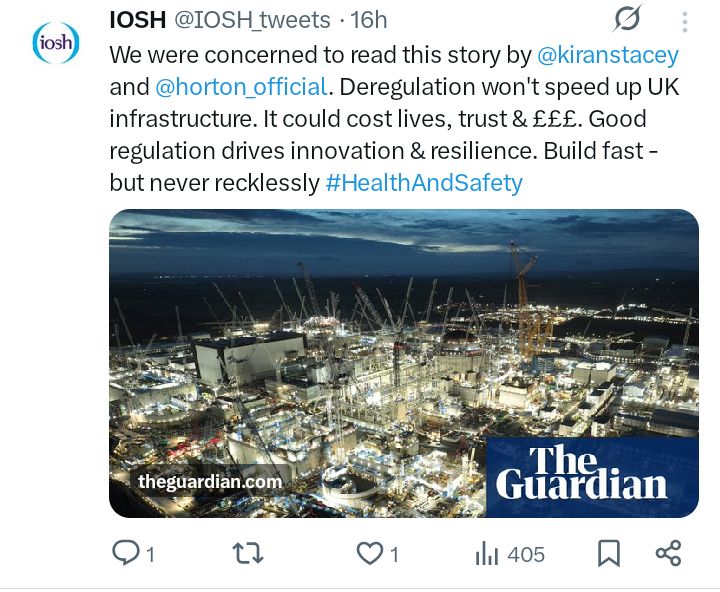
Rather than viewing regulation as “red tape,” IOSH emphasizes that good regulation drives innovation and resilience. Clear safety standards push designers, engineers, and contractors to think smarter—finding safer, more efficient ways to build.
Well-regulated environments encourage better planning, stronger risk management, and technologies that prevent harm before it happens. In this sense, regulation becomes a catalyst for progress, not a barrier.The organization also warns against framing safety as a trade-off with speed.
Infrastructure, IOSH argues, should be built quickly where possible—but never recklessly. Cutting corners on safety does not remove risk; it simply transfers it to workers, communities, and future generations. When things go wrong, the cost is measured not only in money, but in lives lost, injuries sustained, and trust broken.
This debate highlights a broader challenge faced by many countries: how to deliver essential infrastructure efficiently while maintaining robust protections for people and the environment. IOSH’s position is clear. The answer lies not in deregulation, but in better regulation—rules that are well-designed, evidence-based, and consistently applied.
In the end, the question is not whether safety rules slow progress, but whether societies can afford the consequences of ignoring them. As IOSH puts it, we should aim to build fast—but never reckless. When regulation is done right, it does not hold infrastructure back. It ensures that what we build is safe, trusted, and built to last.