


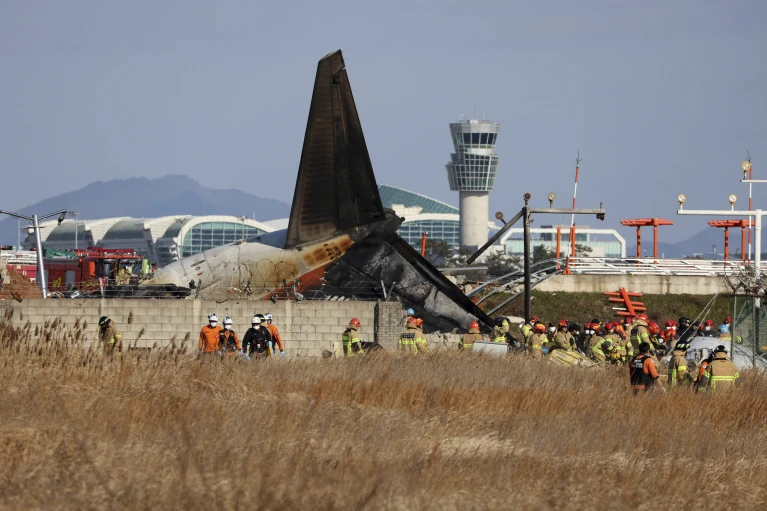
On Sunday, December 29, 2024, a Boeing 737-800 operated by Jeju Air crashed at Muan International Airport in South Korea, resulting in 179 fatalities out of the 181 people aboard.
The incident has quickly become one of the deadliest aviation disasters in South Korea’s history, and the aviation community is now focused on determining the precise cause of the crash.
The complexities of this event highlight several critical safety concerns and raise questions about aviation practices, aircraft performance, and emergency response protocols.
The Incident: A Timeline of Events
The flight, Jeju Air Flight 7C2216, was en route from Bangkok to Muan, located approximately 290 kilometers (180 miles) south of Seoul. As the aircraft approached Muan International Airport for landing, the flight crew encountered difficulties with the landing gear. Despite the pilots receiving a bird strike warning and declaring a mayday, the plane failed to land safely. Instead, it skidded down the runway with its landing gear still retracted, crashed into a concrete barrier, and burst into flames.

The aircraft’s failure to deploy landing gear was a key feature of the disaster, as the video footage and subsequent analysis revealed that the plane skidded at high speed without its flaps or slats deployed. Experts have raised concerns about the potential hydraulic failure, suggesting that the aircraft’s braking systems were not fully operational, resulting in a high-speed landing and a catastrophic collision with the wall.
Key Factors Under Investigation
Several critical factors are under investigation to understand the cause of this tragic accident:
- Landing Gear Failure The failure of the landing gear to deploy is the most striking feature of the crash. The plane’s failure to lower the landing gear is a major safety concern. Landing gear systems are typically equipped with backup systems that can be activated manually or automatically in the event of a primary system failure. However, in this case, the plane’s landing gear was reported to be still retracted at the time of the crash. Aviation experts have pointed out that this is an extremely rare occurrence.The aircraft’s hydraulic system may have failed, or the crew might have been unable to manually deploy the landing gear in time. One possible explanation could be a hydraulic issue that prevented the landing gear from being lowered, but the exact cause remains unclear.
- Bird Strike Warning Authorities reported that the control tower issued a bird strike warning to the flight crew shortly before the crash. While bird strikes are common in aviation, they are rarely the sole cause of a fatal accident. The warning indicates that there might have been birds in the vicinity of the aircraft as it approached the airport. However, experts argue that bird strikes alone are unlikely to have been the primary cause of the crash.A bird strike could have potentially damaged one of the engines, but even in the worst-case scenario, it would not typically result in the loss of the aircraft. Furthermore, a bird strike that affects the landing gear while still retracted would be highly unusual, as the aircraft’s undercarriage would typically be protected from such impacts during flight.
- Pilot Actions and Decision-Making The flight crew’s decision to land in the opposite direction after receiving the bird strike warning raises additional questions. Pilots are trained to make decisions that minimize risk, but changes in landing direction at the last moment can significantly increase workload and reduce reaction time. In this case, the pilots may have been under pressure, and the shift in direction could have complicated their landing efforts, potentially contributing to the accident.Moreover, the failure to deploy the flaps and slats, key systems that slow down the aircraft during landing, is another area under scrutiny. These systems are designed to increase drag and allow for a more controlled, slower descent, which is critical during emergency situations. Their absence likely played a major role in the aircraft’s high-speed descent toward the runway.
- Aircraft Performance and Design The Boeing 737-800 is one of the most widely used commercial aircraft in the world, with a strong safety record. The aircraft’s design has been proven reliable over decades of service, and it has seen use in numerous high-traffic airlines globally. However, even well-established aircraft models are susceptible to failures due to mechanical or environmental factors.The 737-800 is equipped with redundant systems for both hydraulic and electrical failures, which should have allowed the crew to deploy the landing gear. The investigation will need to focus on whether any of these redundant systems failed in this instance or if there was an undetected malfunction in the aircraft’s design or maintenance.
- Emergency Response and Rescue Operations Firefighters and rescue teams responded swiftly to the crash, working tirelessly to extinguish the flames and rescue survivors. While two of the 181 passengers and crew members were pulled from the wreckage alive, the majority of those on board were killed. Emergency response teams faced the significant challenge of navigating through the dense smoke and extreme heat caused by the fire. Their prompt actions were vital in saving the lives of the survivors, but the devastation of the crash underlined the importance of continuous improvement in emergency preparedness and firefighting strategies at airports.
Lessons for the Aviation Industry
While investigations into the exact cause of the crash continue, several key lessons and takeaways can be drawn for the broader aviation industry:

- Aircraft Maintenance and Inspection Protocols The failure of the landing gear to deploy suggests a potential failure in the aircraft’s hydraulic or mechanical systems. This calls for a review of maintenance practices, particularly with respect to aircraft systems that are critical during emergency landing situations. The aviation industry already has stringent maintenance and inspection protocols, but this incident highlights the need for continuous monitoring of system health, especially for older aircraft or systems that have complex redundancies.
- Flight Crew Training and Emergency Preparedness The crash also raises questions about pilot training, especially in emergency scenarios where multiple issues arise simultaneously. While pilots are rigorously trained in emergency procedures, the complexity and speed at which decisions must be made during high-stress situations cannot be underestimated. Flight crews must be trained to manage unforeseen emergencies, particularly when abnormal situations, such as landing gear failures or hydraulic malfunctions, occur alongside other factors like bird strikes or severe weather conditions.
- Safety Measures at Airports Another takeaway concerns the infrastructure at airports. The close proximity of the concrete barrier to the runway in this case may have exacerbated the severity of the crash. The importance of maintaining clear safety zones at airports, particularly at the ends of runways, is critical. While airport design standards have improved in recent years, this tragic incident serves as a reminder that more can always be done to enhance runway safety and minimize risk to aircraft in emergency situations.
- Redundant Systems and Contingency Plans The failure to deploy the landing gear underscores the importance of redundant systems on aircraft. While the Boeing 737-800 is equipped with backup systems for landing gear deployment, the fact that they may not have functioned as intended calls for a thorough examination of these systems. Aircraft manufacturers must continue to innovate and refine backup mechanisms to ensure that failures of this kind are less likely to lead to a catastrophic outcome.
As investigations continue into the tragic crash of Jeju Air Flight 7C2216, aviation experts and safety authorities will focus on uncovering the factors that led to this disaster. While bird strikes, equipment malfunctions, and human decision-making all play a role in the sequence of events, this crash serves as a stark reminder of the complex interplay between various elements in aviation safety.

The aviation community, as well as passengers, must learn from each incident and continue to evolve safety protocols and technologies. While it is too early to determine the precise cause, the lessons from this disaster will likely influence future practices in aircraft design, flight crew training, and emergency response operations, ensuring that such a tragedy becomes a catalyst for safety advancements in the industry.
ALSO READ: When Cutting Corners Costs Lives: The True Price of Safety Neglect