

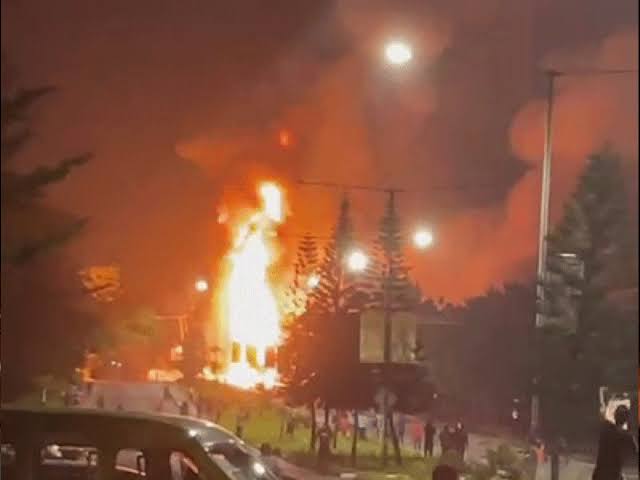

During the hours of the night, fire disasters have occurred unexpectedly across the country. More hazardous than those of daylight, the problems of visibility, low response rate, and unskilled fire knights, have trailed these continuous midnight blaze, Bernard writes.

Recall on May 30, 2020, tragedy occurred when fire gutted Olaleye Market in Somolu, Bariga area of Lagos State in which several items and properties worth billions of naira were destroyed. The raging fire reportedly occurred at about 12.15 am, and razed the market to rubble. Although no life was lost, about 227 identified lockup shops, and several number of vehicles were destroyed in the process estimated to be worth several billions of naira.
On another ocassion, April 3, 2021, the popular Araromi auto spare parts market in Agodi-Gate, Ibadan, was razed by a midnight fire. The fire led to the loss of goods valued at hundreds of millions. The fire was said to have started around 11 pm around the tyre section of the market and spread to other parts of the nearby shops where trailer engines were sold. Sources said the fire was caused by a power surge, which was escalated by nylon used to wrap tyres.
In another midnight fire on Jan 10, 2021, residents of Nnewi, the industrial town of Anambra State, were thrown into panic as the fire razed the multi-million naira factory of Louis Carter Industries Nigeria Limited, at Akaboukwu Uruagu Nnewi, producers of motorcycle spare parts and allied products. The fire outbreak reportedly started at about 10 pm and raged for six hours despite the intervention of men of the fire service, who arrived one hour and thirty minutes after the fire had started. The fire was allegedly caused by Enugu Electricity Distribution Company, EEDC’s high tension cable that exploded and sparked off the fire to the section of the factory.
In an interview with HSENations, the Executive Director, Operations, SGA Technology Limited, George Diala, noted that it was so pathetic and unfortunate that the country had lost billions of naira to fire incidents, due to its non-readiness for fire safety.

While lamenting the poor prevention rate in markets and homes where midnight fires have occurred, he explained that there was need for more alertness at the hours of the night stressing that they are relaxing hours hence response at the time tends to be lower.

Response Rate
The fire expert said, “Midnights are mostly the hours that people are at rest or they are very relaxed and due to this, their response rate is always very low.”
“When fire starts, it is your response rate that will determine whether it will go far. There are ways you will respond to petrol fire or gas fire when trying to quench it that could increase its combustion rate.”
“If you don’t do what it takes for it to go off quickly, the fire will go very far; and before the fire fighters come in, it will have already caused a big havock,” he said.
Prevention
According to Diala, it was wise to ensure that all electrical and energy appliances be switched off at home and in the markets as preventive measures.
“If you check most of the fire that has happened, they have happened at midnight. Occupants of the markets finish their daily activities and leave their electrical appliances on. Some leave their lanterns and candles and go home.”
“So any thing that can cause fire should be switched off, because prevention is better than cure. We should switch off things that can cause fire and not relax concerning them,” he said.
Fire Equipment
Diala further decried the lackadaisical priority given to fire equipment in the country noting that some fire extinguishers and other fire equipment used in vehicles and companies were obsolete.
“Some of the ones we even see inside companies and offices are just for regulation sake; so they do not even do fire safety training consistently with workers and house maids.”
“How many of our markets have what it takes to prevent fire? If you go to big markets like Tejuosho market- they are supposed to have smaller fire trucks that should be in the market that can be used before the fire service comes,” he said.
He added that more upgraded forms of fire equipment and technologies be applied to quelling the hazardous impact of raging fire.
“There are paints with fire suppressants that are used during building constructions that have the capacity to resist fire. These are the kind of technologies that need to be applied,” the safety expert recommended.
Also speaking with HSENations, Chief Executive Officer, Surveillant Fire Ltd, Jumade Adejola, revealed that the major challenge of midnight fire was ‘visibility’ and also called for proper fire service equipment to be put in place by the government. He also called for more training of fire fighters for challenges of midnight fire.

“The major challenge is visibility. When there is a fire incident generally, the first thing that goes off is the power. That is why the fire fighters make use of Thermal Image Camera to identify whether people are present at the scene of the incident or not.”
“I cannot say that our fire fighters are not trained for midnight rescue operations. They are trying their best, but they are not well equipped. There are not sufficient fire trucks. We need to put in place all these fire systems, like hydrant system,” he said.
Provision of Water
While also decrying the quality of water system engaged in fighting fire, he laid emphasis to the Opic Plaza fire disaster that occurred around 10pm at Ikeja.
According to him, “Water tankers should have enough water. The fire trucks we are talking about cannot carry more than five litres of water. These five litres are used up in less than five to ten minutes and will not take out the fire completely. They rely on the Water Corporation Recycling Plant which does not have much pressure.”
“They should go and get their own pump separately, install it and the pump will be 24 hours on, so that anytime they open the water, the pump will start working.”
“What does it cost them? They can even run the hydrant from the lagoon or from the sea. They can put the pump there and then run the link to the hydrant so that everywhere in Lagos State whenever they put on that hydrant, water will come out with pressure,” the fire engineer stressed.
He added that the government needed to involve and call on critical stakeholders who could proffer practical and not just theoretical solutions to the problems of fire in the country.