



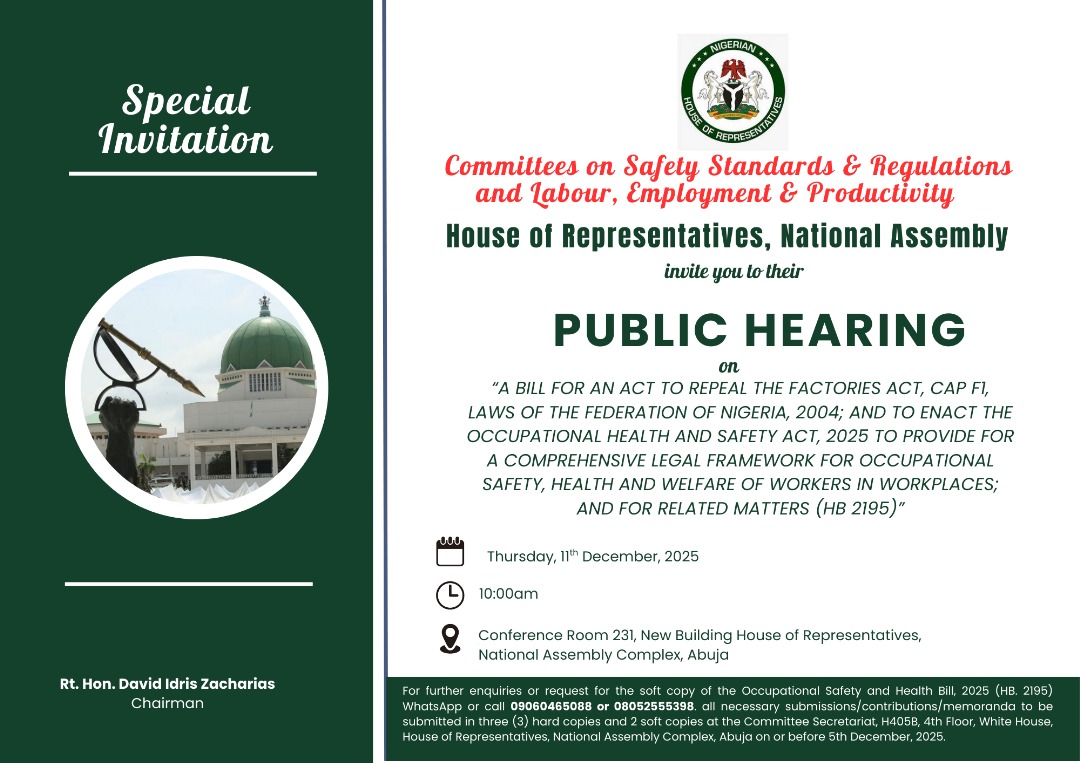
Nigeria is on the verge of one of its most significant workplace safety reforms in decades as the House of Representatives prepares for a public hearing on the Occupational Health and Safety Bill, 2025 (HB 2195).
The Committees on Safety Standards and Regulations and Labour, Employment and Productivity have invited stakeholders, professionals and the general public to a session scheduled for Thursday, 11 December 2025 at the Conference Room of the New Building, National Assembly Complex, Abuja.
The landmark bill seeks to repeal the current Factories Act, enacted in 2004, and replace it with a modern Occupational Health and Safety Act designed to protect workers across all sectors. Unlike the old law which focuses heavily on factories and industrial environments, the new Act proposes a comprehensive legal framework that covers every type of workplace, including offices, construction sites, farms, laboratories, hotels and informal work settings.
It also establishes a National Council for Occupational Safety and Health to coordinate standards, enforcement, reporting systems and national accident data.
The public hearing invites written memoranda, submissions and recommendations from safety professionals, organised labour groups, HSE consultants, employers, civil society and industry associations. Interested contributors may request a soft copy of the bill through the official contacts provided. Submissions must reach the National Assembly on or before 5 December 2025.
Why this matters for HSE practice in Nigeria
This proposed Act represents a transformational shift in how Nigeria defines and enforces workplace safety. For decades, the Factories Act was criticised for being outdated, limited in scope and poorly aligned with modern work environments.
The new bill expands the definition of a workplace, introduces clearer employer duties, strengthens enforcement powers and addresses areas like ergonomics, occupational hygiene, welfare facilities, training, worker participation and accident reporting.
From a professional standpoint, the bill holds significant implications. It will require employers to adopt structured HSE management systems instead of relying on fragmented compliance. It will also create legal backing for risk assessments, safety audits, safety committees and mandatory training standards that many organisations currently treat as optional. Stronger penalties for violations will improve accountability and ensure that safety is not an afterthought.
The reforms also promise better protection for workers in high risk sectors such as construction, manufacturing, oil and gas, transportation and waste management. With rising injury rates and recurring industrial accidents, a modernised safety law is essential for safeguarding lives, preventing economic losses and raising industry standards. If successfully implemented, the Occupational Health and Safety Act, 2025 could become the foundation for a new safety culture across Nigeria.